Inflation: What It Quietly Does to Savings, and What Has Actually Beaten It
Seeing what inflation does to cash is one of the hardest money jobs, because the loss never appears on a statement. Here is the quiet math, what has actually kept up, and what to do about it.

Seeing what inflation does to savings is one of the most difficult money jobs, not only for people holding cash but for anyone whose bank balance never goes down and who therefore assumes nothing is happening. The work involves subtracting inflation from a stated return before deciding it pleased you, holding only as much cash as has a job, owning productive assets for long-horizon money, and noticing that your personal inflation rate is not the headline number.
On the other hand, once you can see the quiet math, the case for an emergency fund in cash and a long-horizon portfolio in productive assets becomes much clearer. Cash buys liquidity. It does not buy returns. Equities have been the most reliable long-run hedge because companies with pricing power raise prices when costs rise. They are also often a poor short-run hedge, which is a different job.
Here are some things you can do to stop treating a shrinking pile of purchasing power as a stable balance.
The quiet math
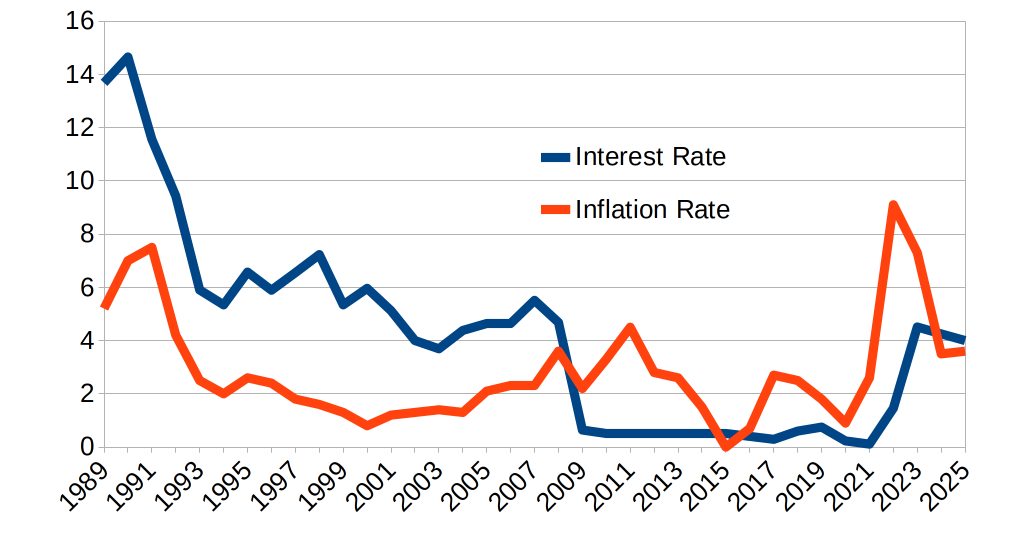
At 3% inflation, unremarkable by historical standards, $10,000 left in cash buys about $8,600 of value after five years, $7,400 after ten, $4,100 after thirty. Thirty years of doing nothing wrong, and roughly 60% of the value is gone. Nobody stole it. No market crashed. No statement ever showed a loss. At 6% inflation, the level much of the world saw in 2022, the halving point arrives in twelve years instead of twenty-four. The Rule of 72 works in reverse here too. A savings account paying 4% while inflation runs at 3% is not earning you 4%. It is earning about 1% in real terms, the only number that determines whether you can actually buy more than before.
Four things to actually do about it
1. Find your own inflation rate, not the headline one. The published figure averages a basket meant to represent a typical household, and you are not one. If rent, education or healthcare dominate your spending, categories that have persistently outpaced the general index, your real rate runs hotter than the news suggests. Check the category-level detail behind the average on the Bureau of Labor Statistics site, and plan against your own number rather than the headline, since the gap quietly under-funds a plan for years.
2. Hold only as much cash as has a job. Emergency reserves and known near-term spending, and nothing beyond that. Every dollar sitting idle past those two purposes is a decision to accept guaranteed erosion, not a neutral choice, so name what each pile of cash is for and move the rest.
3. Own productive assets for long-horizon money. Equities have been the most reliable long-run hedge because companies with pricing power raise prices when costs rise and revenue follows, held through a diversified portfolio rather than concentrated bets. They are also a poor short-run hedge, 2022 proved that when inflation spiked and stocks fell anyway as rising rates compressed valuations faster than earnings could catch up, so this only works on a horizon of a decade or more.
4. Use inflation-linked bonds for the part of the plan that cannot take equity risk. TIPS in the US adjust principal to a published inflation index and do the specific job precisely, at the cost of modest real returns. This is the right tool for money you genuinely cannot afford to see fall, not a replacement for equities in the rest of the plan.
What not to do
Do not reach for gold or bitcoin as the primary inflation hedge. Gold's reputation outruns its record, it has roughly held value over very long stretches and badly lagged over decade-long ones, which is the horizon most people actually plan on. Bitcoin's history is too short and too correlated with risk assets to say much with confidence, covered in sizing bitcoin in a portfolio. Both are reasonable small satellite positions, neither is a foundation.
Where this leaves you
Work out your own inflation rate from what actually dominates your spending, then check what share of your savings is cash with no job attached. That second number is usually larger than people expect once they actually total it up, and moving it into productive assets is the highest-leverage single action available here.
If your personal rate looks very different from the published figure and you are unsure what to do about it, bring it to the Discord below. That gap is where general advice stops being useful.
FAQ
Is holding cash ever the right call? Yes, for money you need soon or for an emergency fund. It is the wrong call for money that will not be touched for decades.
Does gold reliably beat inflation? Not reliably. It has roughly held value over very long stretches and lagged badly over shorter, decade-long ones.
How do I find my own real inflation rate? Look at what actually dominates your spending. The Bureau of Labor Statistics publishes category-level detail behind the headline figure.
Not investment advice. Historical asset performance does not guarantee future results. Inflation rates, tax treatment and available instruments vary by country.