Diversification: What It Actually Protects You From (And What It Doesn't)
Building a diversified portfolio is one of the most repeated jobs in investing, and one of the most misunderstood. Here is what it actually protects you from, what it does not, and how to check you have it.

Building a diversified portfolio is one of the most repeated jobs in investing, not only for beginners but for anyone who owns several funds and still has one big bet. The work involves knowing the difference between company-specific risk and market-wide risk, checking that your holdings actually move for different reasons, looking outside the portfolio at your job and your city, and then accepting that you will never hold the single best-performing mix.
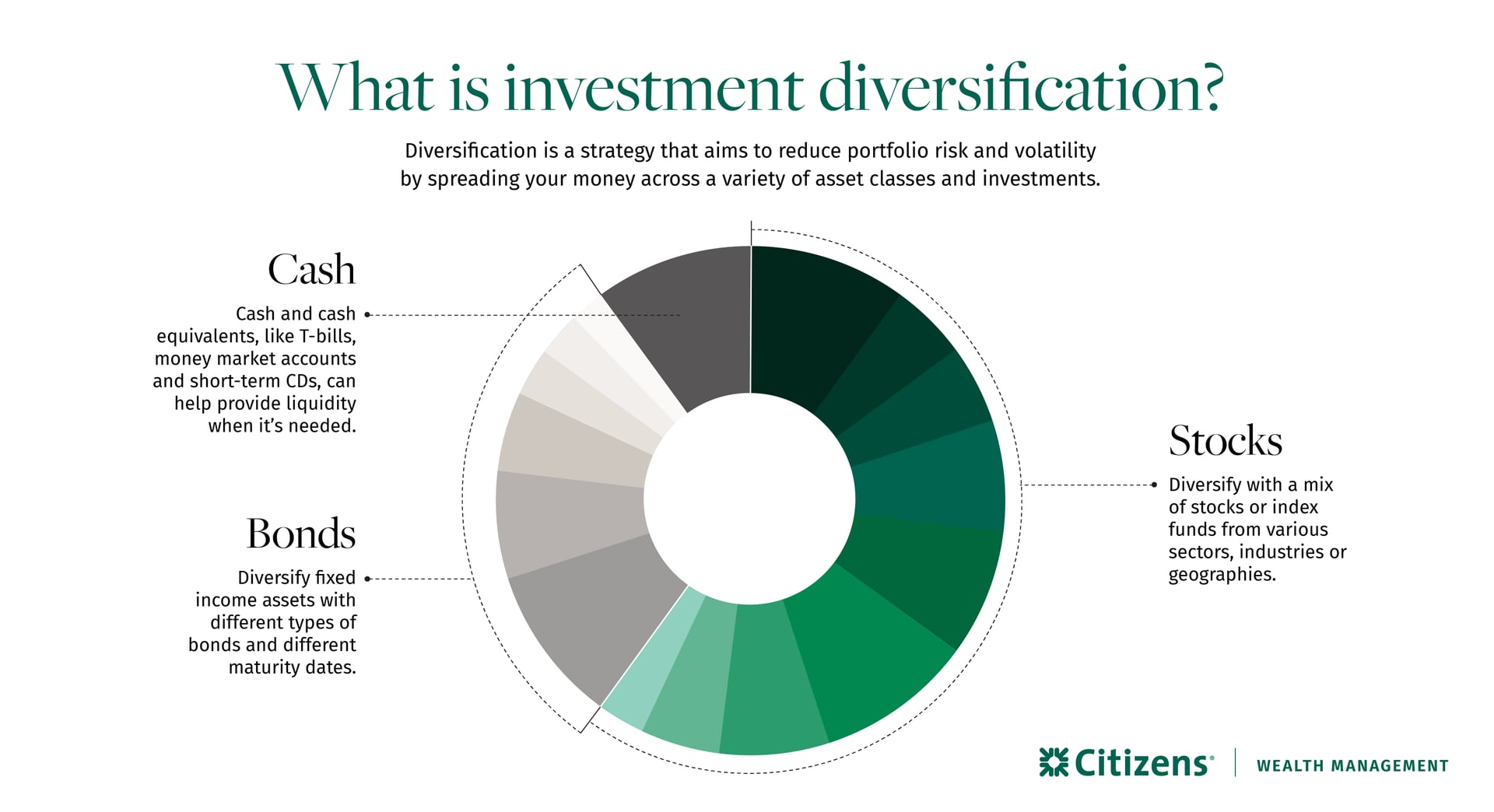
On the other hand, genuine diversification is what keeps a factory fire, a failed product, or a bad CEO from becoming a disaster. An index fund does the company-level version cheaply. Spreading across asset classes does the most in a real downturn. Spreading across time, which is what dollar-cost averaging is, does the rest.
Here are some things you can do to diversify in a way that actually changes the risk, not just the number of tickers.
Two kinds of risk, only one of them fixable
Specific risk belongs to one company: a factory fire, a failed drug trial, a bad CEO. These are mostly independent events, so owning many companies turns a disaster into a dent. Market risk belongs to everything at once: a recession, a rate shock. When that hits, owning fifty stocks instead of five does not save you. Diversification kills the first almost entirely and does nothing for the second. Most of the benefit shows up by twenty to thirty genuinely different holdings. Going from twenty-five to a hundred adds comparatively little. The catch is "genuinely different." Thirty US tech holdings are not thirty bets. They are one bet held thirty times.
Four axes that actually diversify a portfolio
1. Across companies, which one index fund solves instantly. Owning twenty to thirty genuinely different companies captures most of the available benefit, and a single broad index fund does that for hundreds of companies at once for a few basis points. This axis is the easiest to fix and the one most portfolios already have covered.
2. Across correlation, which is the one people miss entirely. Two assets that move in lockstep achieve nothing held together, however different their names sound. What actually helps is holdings whose fortunes depend on different underlying causes: different economies, different rate sensitivities, different customers. Check what your holdings actually have in common before assuming a mix of tickers is a mix of risks.
3. Across your own income, not just your investments. If you work at a listed company and hold its stock through options or a vesting plan, your salary and your savings depend on the same employer. Someone who works in tech, lives in a tech-dominated city, and holds a tech-heavy portfolio has made one enormous bet across three parts of their life at once. Write down what your employer, your city and your portfolio all depend on, and if the same word appears more than once, diversify the portfolio away from it deliberately.
4. Across time, so no single entry price decides the outcome. Investing on a schedule rather than all at once means you never bet everything on one day's price. This is dollar-cost averaging applied to diversification, and it is the axis people forget exists because it does not show up as a line item on a statement.
What not to do
Do not expect diversification to protect against a full market decline. It kills company-specific risk almost entirely and does nothing for market-wide risk, and mixing up the two is how people get blindsided when a downturn hits everything they own at once regardless of how many tickers were in the portfolio.
Do not chase the appearance of diversification either. Owning an S&P 500 fund, a Nasdaq-100 fund and a tech sector fund together is not three positions, it is the same handful of mega-cap companies held at three concentrations while you pay three sets of fees for the privilege.
Where this leaves you
Diversification guarantees you will never hold the single best-performing portfolio, since by construction you always own some of whatever is currently lagging. That is the trade: give up the best possible outcome to eliminate the worst one, worth it for anyone whose plan needs the money in twenty years, and it will not feel worth it during a bull run in the thing you chose not to own.
Check your top holdings for real overlap this week, and write down what your job, your city and your portfolio have in common. That second check catches the concentration almost nobody looks for.
If you are carrying employer stock and unsure how much is too much, bring it to the Discord below. It is the case where the general rule and somebody's real circumstances diverge most.
FAQ
How many stocks do I actually need to be diversified? Roughly twenty to thirty genuinely different companies, or one broad index fund that already holds hundreds.
Does diversification protect against a full market crash? No. It protects against one company or sector going wrong, not the whole market falling together.
What's the most commonly missed source of concentration? Your own job. Working in the same industry your portfolio is concentrated in doubles the bet without anyone noticing.
Not investment advice. Diversification reduces some risks but cannot prevent losses. Past correlations between asset classes are not guaranteed to persist.