The Behaviour Gap: Why Investors Earn Less Than Their Own Funds
Earning what your own fund returns is one of the hardest jobs in investing. Here is why the average holder underperforms the fund, and the structural fixes that actually work.

Earning the return your own fund actually produced is one of the most difficult jobs in investing, not only for beginners but for anyone who has ever bought after a good run and sold after a bad one. The work involves seeing that the fund's stated return assumes you held it the whole time, noticing the biases that make selling feel urgent at the worst moment, and then removing decisions instead of trying to make better ones in the heat of a decline.
On the other hand, closing that gap can do more for a portfolio than picking a slightly better fund. Morningstar has measured it repeatedly in its Mind the Gap studies, and it is often a bigger drag on returns than fees, tax and fund choice combined. Automating contributions, writing a one-page policy while you are calm, and checking the account quarterly instead of daily are dull, and they are the things that actually keep people invested.
Here are some things you can do to stop being the reason your returns lag the fund you already own.
Why the average holder earns less
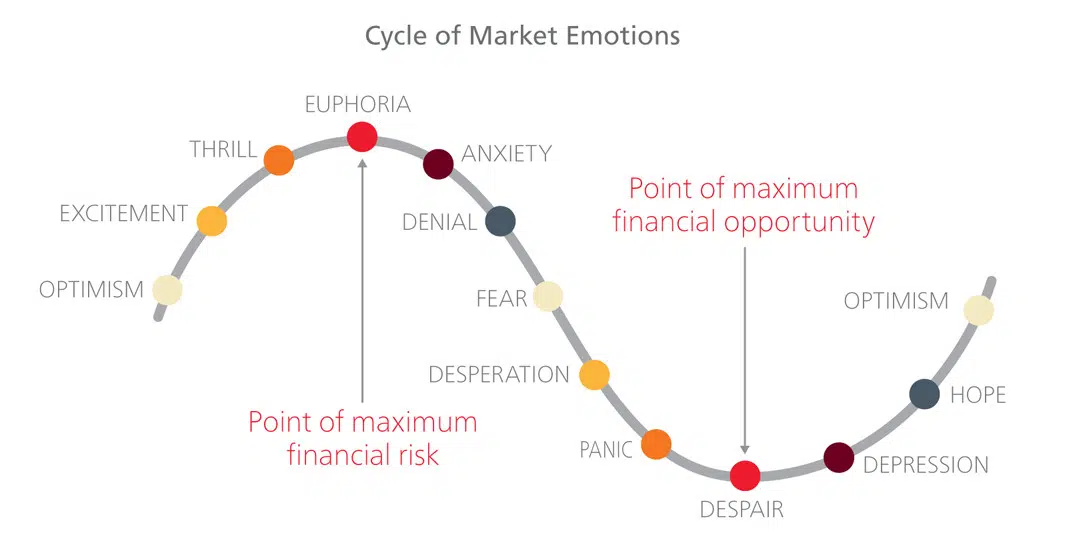
A fund returns 8% a year. The average person holding it earns 6%. That sounds impossible until you realise the fund's return assumes continuous holding, and most people do not. They buy after a good run and sell after a bad one. Losses hurt roughly twice as hard as equivalent gains feel good, one of the most robust findings in behavioural research. It makes selling feel urgent during declines, exactly when selling does the most damage. Recency bias does the rest. Three good years and risk feels theoretical, so people add more. A crash and permanent decline feels obvious, so people retreat to cash. Fund inflows peak near market tops and outflows peak near bottoms, millions of individually reasonable decisions landing at collectively the worst moment.
The other traps: overtrading, confirmation, anchoring
Most people rate themselves above-average investors, which is arithmetically impossible for most of them. The result is trading too much, and brokerage research consistently finds more active traders earn lower net returns. Every trade carries a cost and requires being right twice, on the exit and the re-entry. Own something and you start reading about it differently. Bullish arguments feel insightful, bearish ones feel like noise. That is what turns a position into an identity. Write down in advance, in plain words, what would change your mind. If nothing would, you are holding a belief, not an investment. Anchoring is fixating on an old reference point: "it was $200 last year, so $120 is cheap." The old price is not evidence about current value.
Four fixes that actually work
None of the biases above go away from knowing about them. What works is structural, removing the decision instead of trying to improve it in the moment of feeling it.
1. Automate contributions. A standing transfer invests on schedule regardless of headlines, which is dollar-cost averaging working as a behavioural tool rather than a mathematical one. Set it up once and the decision to buy stops being a decision you have to make correctly every month.
2. Write a one-page investment policy while calm. What you own, why, your target allocation, and what would make you change it, written down before you need it and followed when you do not feel like it. This single document is what you consult during a decline instead of your feelings, and it is worth nothing unless it is written before the decline starts.
3. Rebalance on a fixed rule, not a feeling. Annually, or at a set drift threshold, so the portfolio forces you to sell what has run and buy what has lagged. This is the mechanical opposite of what recency bias pushes you to do, which is exactly why it works.
4. Check the account less, and keep an emergency fund. Quarterly is enough for a decades-long plan, since checking daily maximises the number of times you see a loss and loss aversion does the rest. An emergency fund does the other half of the job, making sure a market decline and a personal crisis never have to compound each other.
What not to do
Do not assume awareness of these biases is a defence against them. Most people rate themselves above-average investors, which is arithmetically impossible for most of them, and the confidence that produces overtrading is generally uncorrelated with actually being right. Reading this article and believing you are now immune is itself the overconfidence bias in action.
Where this leaves you
Write the one-page policy this week, while nothing is happening. It is worth very little today and a great deal during the next decline, because it is the document you will actually consult instead of your feelings.
Most investors do not need better analysis. They need to interfere less with decisions they already made correctly, and the four fixes above exist specifically to make that easier than willpower ever could.
If you have caught yourself about to do something you suspect is a bias rather than a decision, the Discord below is a good place to say it out loud first. That sentence spoken to somebody else is often enough on its own.
FAQ
Why does the average investor underperform their own fund? Timing. The fund's stated return assumes continuous holding. Most people buy and sell at the wrong moments instead.
Does knowing about these biases help avoid them? Not by itself. Structural fixes, automation, a written policy, checking less often, work far better than willpower.
What's the single most effective behavioral fix? Automating contributions. It removes the decision entirely rather than asking you to make the right one every month.
Not investment advice. Behavioural research findings describe averages across populations and do not predict any individual's outcome.